

Latest
Press Release
02 December 2025
Secretary-General appoints Stefan Priesner of Austria as the United Nations Resident Coordinator in India
Learn more
Story
28 November 2025
India’s winter air turns toxic: UNEP warns crisis is ‘nearing disaster levels’
Learn more
Story
26 November 2025
Digital Abuse in Focus as UN Opens 16 Days of Activism
Learn more
Latest
The Sustainable Development Goals in India
India is critical in determining the success of the SDGs, globally. At the UN Sustainable Development Summit in 2015, Prime Minister Narendra Modi noted, “Sustainable development of one-sixth of humanity will be of great consequence to the world and our beautiful planet. It will be a world of fewer challenges and greater hope; and, more confident of its success”. NITI Aayog, the Government of India’s premier think tank, has been entrusted with the task of coordinating the SDGs, mapping schemes related to the SDGs and their targets, and identifying lead and supporting ministries for each target. In addition, the Ministry of Statistics and Programme Implementation (MoSPI) has been leading discussions for developing national indicators for the SDGs. State governments are key to India’s progress on the SDGs as they are best placed to ‘put people first’ and to ensuring that ‘no one is left behind’. The UN Country Team in India supports NITI Aayog, Union ministries and state governments in their efforts to address the interconnectedness of the goals, to ensure that no one is left behind and to advocate for adequate financing to achieve the SDGs.
Publication
12 November 2024
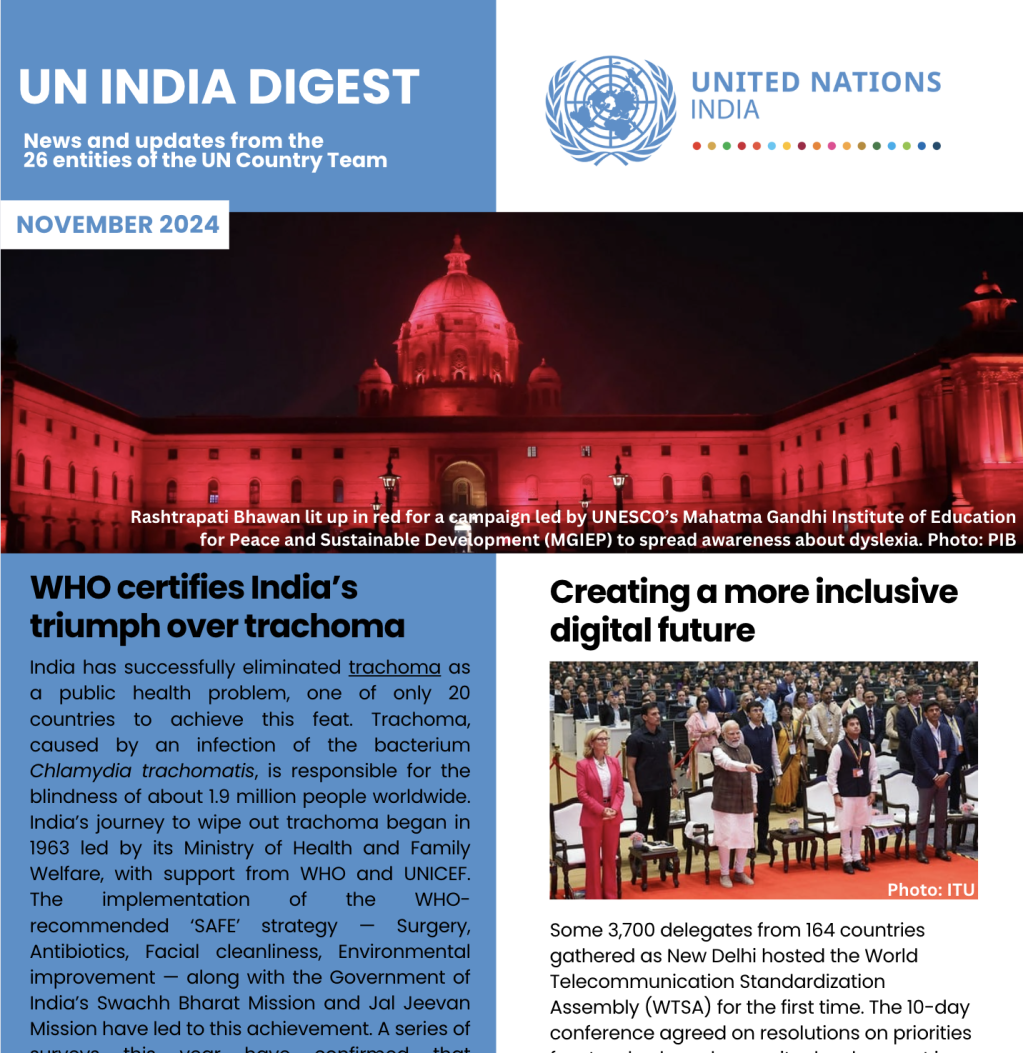
UN in India Digest November 2024
WHO lauds India's elimination of trachoma, eight new resolutions adopted at the ITU World Telecommunication Standardization Assembly, glimpses of the UN Day celebrations in New Delhi and more updates from the 26 entities of the UN country team in this special edition of the United Nations in India newsletter.
Story
28 November 2025
India’s winter air turns toxic: UNEP warns crisis is ‘nearing disaster levels’
A pale, opaque haze has once again settled over north India. For millions in Delhi and nearby regions, winter has become a season of masks, burning throats, stinging eyes, and a growing fear that even breathing may be harming their health.“This is no longer just an environmental issue. We are breathing ourselves to death,” says Dr. Balakrishna Pisupati, Head of the United Nations Environment Programme (UNEP) in India. “An Air Quality Index (AQI) of 400 or 500 is 35 times higher than international safe limits. That is air in the severe category — dangerous for everyone.”Across India’s northern plains, these numbers have become unsettlingly familiar. But the science behind the haze tells a deeper story.The winter trapEvery November, as temperatures drop and winds still, the atmosphere transforms. Cold air becomes dense and heavy, refusing to rise. Pollutants — dust, smoke, industrial emissions, vehicle exhaust — get trapped close to the ground like a blanket pulled tight over the city.“In summer, rising warm air carries pollutants upward. But in winter, the air is dense and barely moves,” explains Dr. Pisupati. “Delhi often sees wind speeds of just 3 or 4 kilometres an hour. That means whatever enters the air stays there.”Delhi’s geography amplifies this trap. Surrounded partially by the Himalayas, the region around the capital forms a shallow bowl. The pollutants have nowhere to go.This meteorological cocktail has turned the winter months into a predictable health emergency.Many sources, not one villainMuch of the public conversation narrows the crisis to a single cause: crop-residue burning in neighbouring states. But UNEP’s assessment paints a broader, more complex picture.“There is no single culprit,” says Dr. Pisupati. “Construction dust, brick kilns, industries, vehicular emissions, diesel exhaust, crop burning — each of these contributes. What changes in winter is that the dispersion mechanism collapses. Everything accumulates.”Different pollutants overlap, interact, and settle in the lungs of people living across Delhi National Capital Region (NCR) and beyond. The result is an annual spike in asthma, bronchitis, cardiovascular strain and respiratory infections.A long road aheadIndia has taken notable steps. The Commission for Air Quality Management (CAQM) — a statutory authority — oversees coordination across states. The National Clean Air Programme (NCAP) seeks to reduce particulate pollution. Investments in monitoring networks, forecasting tools, and emergency action plans have increased.But Dr. Pisupati cautions that even the strongest policies falter without broad cooperation. “You cannot solve this in two months. Air pollution must be managed all year round, and by all stakeholders — governments, industries, households, commuters, resident welfare groups, and enforcement agencies. Behavioural change is essential.”Compliance remains uneven. So does public participation.“We need people to reduce burning, follow advisories, rethink vehicle use, manage waste better, and take responsibility at the community level,” he says. “Without that, even the best policies will fall short.”Where is India headed? Towards stabilisation or deeper crisis?The UNEP assessment is blunt.“Air pollution in India is close to becoming a disaster,” says Dr. Pisupati. “Its effects are not limited to a season. Pollutants that enter the body now stay much longer.”The solution, he argues, rests on three pillars:1. Policy coherence across ministriesYou cannot subsidise polluting activities in one sector while trying to reduce emissions in another.2. Cross-state cooperationAir does not recognise borders. Regional coordination is essential.3. A multistakeholder, people-centred modelIndustries, micro-enterprises, civil society, youth, media, academia, and health professionals must work together.UNEP has launched an Air Quality Action Forum, a platform where large and small industries, community groups, experts, media, and young people collaborate on solutions — from technology upgrades to clean operations to behaviour change.Climate, development, and behaviourIndia’s climate transition is accelerating. The country is among the largest adopters of renewable energy, surpassing some of its own 2030 goals ahead of schedule. Yet, air pollution persists.“Policies and investments can take us far, but without behavioural change, we will not succeed,” Dr. Pisupati stresses. “Environment is unique — everyone is impacted by it, and everyone contributes to its problems.”UNEP and India’s Ministry of Environment are now designing a national-level behaviour change programme aimed at reducing individual environmental footprints.
1 of 5

Story
26 November 2025
Digital Abuse in Focus as UN Opens 16 Days of Activism
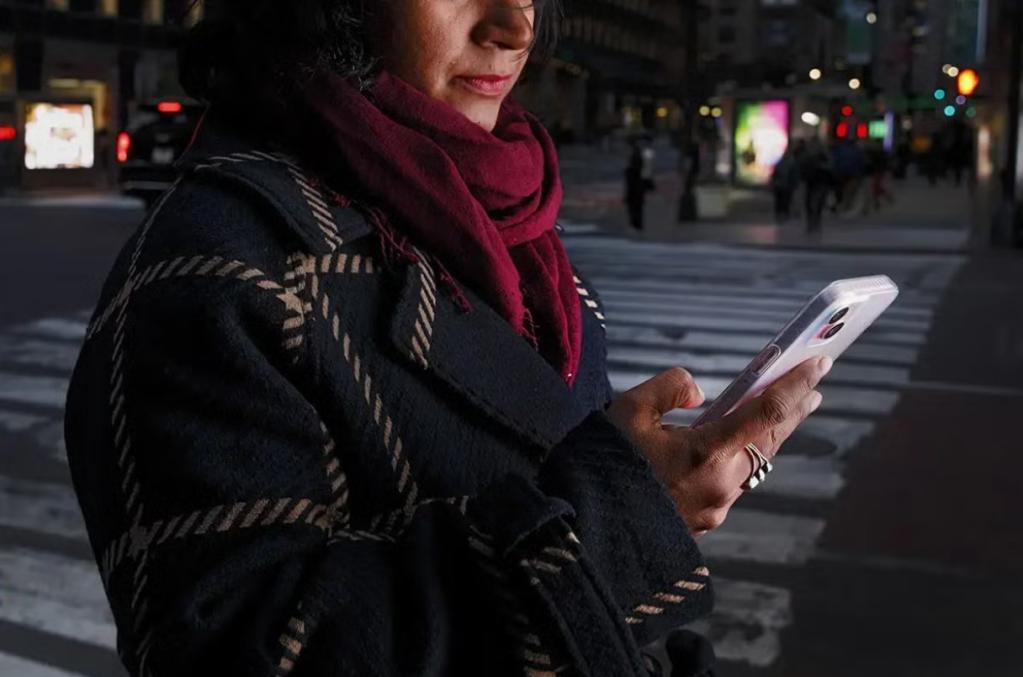
The United Nations has launched its annual 16 Days of Activism against Gender-Based Violence, placing a growing form of abuse at the centre of global attention. Running from 25 November to 10 December, the campaign links the International Day for the Elimination of Violence against Women with Human Rights Day and highlights the sharp expansion of technology-facilitated violence. UN Women reports an accelerating rise in online harassment, cyberstalking, gendered disinformation, image-based abuse and the use of artificial intelligence to create manipulated sexual content. Research indicates that between 16 and 58 percent of women have experienced some form of digital abuse. An estimated 90 to 95 percent of deepfake videos circulating online are sexualised images of women.To mark the start of the campaign, UN Women and the UN Office on Drugs and Crime released Femicides in 2024, the latest global assessment of killings committed by intimate partners or family members. The findings point to a persistent and deeply entrenched pattern. About 83,000 women and girls were deliberately killed last year. Nearly 60 percent of them, or around 50,000, were murdered by a partner or family member. The agencies note that this level of lethal violence has shown no meaningful decline in recent years.The figures amount to one woman or girl killed by someone in her family almost every ten minutes. By comparison, only about 11 percent of male homicides were carried out by intimate partners or family members.The report also highlights how digital tools have become intertwined with physical violence. Technology has increased the reach of cyberstalking, coercive control and image-based abuse. In several documented cases, it has escalated existing threats and contributed to killings.In a message issued for the International Day, the Secretary-General urged governments to criminalise digital violence and expand support for survivors. He called on technology companies to make platforms safer and more accountable and urged communities to reject online hate, noting that digital spaces must not become yet another arena where women and girls are at risk. This year’s campaign offers a series of public resources, including guidance on online safety and material explaining how artificial intelligence is accelerating technology-facilitated abuse. Over the 16 days, the UN is calling for stronger accountability for perpetrators, higher safety standards across digital platforms and sustained funding for women’s rights groups working to prevent and respond to violence. Additional resources: Campaign pageExplainer “Online safety 101”Explainer “How AI is amplifying digital violence and what to do about it” ***
1 of 5
Story
12 November 2025
‘Solidarity is a life jacket’
Conflicts are increasingly handled as they arise rather than through attention to the deeper conditions that drive them, said an Independent UN human rights expert.Peace, Cecilia M Bailliet warned, is being narrowed as global politics leans toward managing conflicts rather than addressing the conditions that give rise to them. Speaking at Jawaharlal Nehru University during UNESCO MGIEP’s twelfth Distinguished Lecture, the UN Independent Expert on human rights and international solidarity said this shift is shaping how peace is understood in a more multipolar world.Her lecture examined solidarity and the deeper forces behind conflict. She described positive peace as the work of securing equality and non discrimination and confronting the structural violence that pushes people to the margins. International solidarity she noted supports this by promoting policies that free vulnerable groups from exclusion and oppression.She also underlined the place of the right to peace in international law and in education, saying it supports every other right and should guide how young people learn about global affairs. Rising militarisation was another of her concerns and she urged greater participation of women in peace efforts from negotiations and treaty processes to national dialogue. Their leadership she said has been steady and effective in many settings.In her interview with the UN, Ms. Bailliet described solidarity as an action that helps people enjoy their rights in everyday life. It can mean ensuring access to housing health care or digital services and taking responsibility instead of waiting for others to act. She noted that the pandemic weakened human connection and said communities now need to rebuild those ties. Women and young people she added are giving this work fresh force through approaches shaped by care and responsibility.Solidarity she said is a life jacket. “Not ornamental. Not optional. The thing you put on before the boat hits rough water.”Watch the full interview below: Cecilia M. Bailliet was appointed by the Human Rights Council as Independent Expert on human rights and international solidarity in October 2023.
1 of 5

Story
31 October 2025
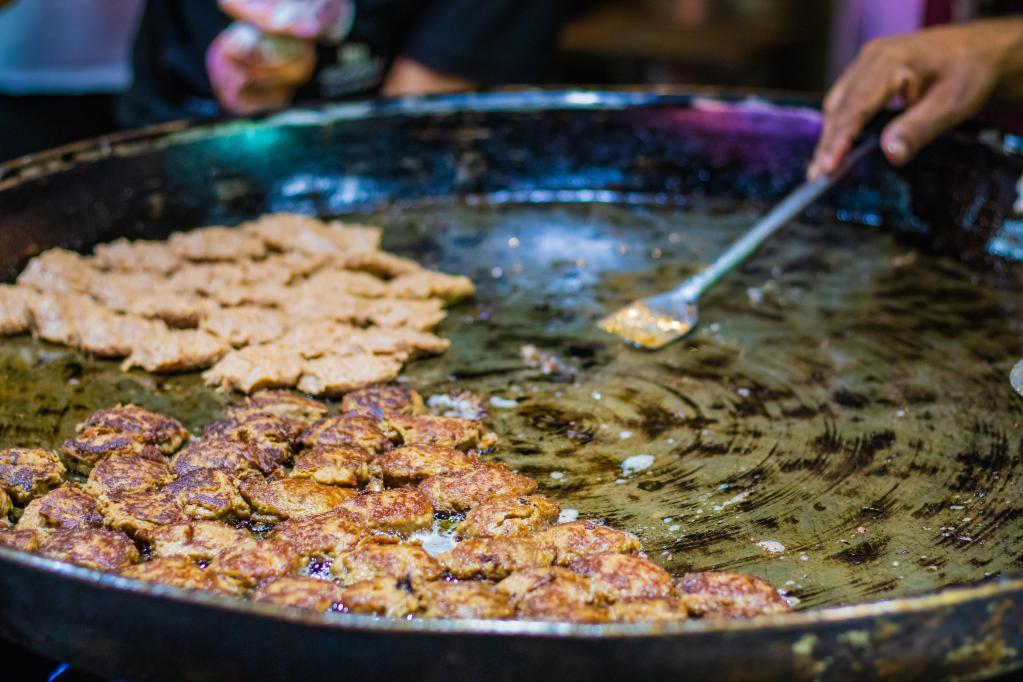
UNESCO enshrines Lucknow on world’s culinary map
From its famous street foods to its royal kitchen traditions, Lucknow’s cuisine has brought together history, innovation and community spirit for centuries. Now the city has earned a place on the official global culinary map after UNESCO named it a Creative City of Gastronomy. The designation was announced by UNESCO on 31 October, World Cities Day, as part of 58 additions this year to its Creative Cities Network (UCCN). Lucknow becomes the second Indian city to be added to UCCN’s gastronomy category, after Hyderabad was named in 2019. Announcing the designation, UNESCO paid tribute to Lucknow’s historic Awadhi cuisine as well as its flair for culinary creativity. The city is renowned for many distinct dishes, including its succulent kebabs and distinctive take on biryani. With this recognition, Lucknow becomes one of 408 cities across more than 100 countries that have been acknowledged for their contributions to creative industries such as crafts and folk art, design, film, gastronomy, literature, media arts, and music. This year, architecture has been introduced as a new creative field within the network. “Lucknow’s recognition as a UNESCO Creative City of Gastronomy is a testament to its deep-rooted culinary traditions and vibrant food ecosystem. This designation honors the city’s rich cultural legacy while opening new avenues for international collaboration,” said Tim Curtis, Director and Representative, UNESCO Regional Office for South Asia. The UCCN aims to strengthen international cooperation among cities that recognize culture and creativity as drivers of sustainable urban development. Launched in 2004, it supports cities that invest in cultural industries, empower creative professionals, and engage communities to promote inclusion, jobs and economic vitality. ***
1 of 5
Story
24 October 2025
UN Day 2025
Under the global theme Building Our Future Together, the United Nations marked its 80th anniversary, a moment to celebrate eight decades of peace, human rights, and international cooperation, while renewing the collective commitment to a shared and sustainable future.Eighty years on, the United Nations remains a living legacy of multilateralism. Its story is one of endurance and purpose, shaped by generations who believed that dialogue and cooperation must prevail over conflict and isolation. The anniversary serves not only as a tribute to that legacy but also as a call to strengthen it — to make the UN more inclusive, more effective, and more responsive to the needs of the next generation.Senior UN leaders reflected on this milestone and the vision it represents. Secretary-General António Guterres reminded the world, ““We are all privileged to be part of one of the most ambitious and profound undertakings in human history. The decision, despite our differences, to solve problems together, to work sincerely, creatively and humbly toward a better future for all.”President of the General Assembly Annalena Baerbock observed that “we often forget in the trenches of bureaucracy, politics, and diplomacy, how much this institution matters to ordinary people.”UN Deputy Secretary-General Amina Mohammed spoke of unity and renewal, noting that “in this 80th year of the United Nations, it is time to make that choice again and to move forward better together as one human family, as one institution serving humanity.”Under-Secretary-General for Global Communications Melissa Fleming reflected that “we have a United Nations that has an amazing and rich history that we can all be proud of. But that we also have at 80, a United Nations that is renewed, and together, we can be part of its living legacy.”In India, the day was marked with the unveiling of a commemorative UN Day 2025 postage stamp by External Affairs Minister S. Jaishankar at the Ministry of External Affairs. Later in the evening, UN House in New Delhi hosted a reception that brought together diplomats, government officials, and cultural performers to celebrate both United Nations Day and the organisation’s 80th anniversary, an occasion that reflected the spirit of unity and shared purpose.Around the world, the United Nations is marking this milestone with the global photo exhibition Shared Lives, Shared Future, organised by the UN Department of Global Communications in collaboration with the Governments of Italy, Slovenia, and Switzerland. The exhibition features over 200 human stories from all 193 Member States and celebrates the diversity and resilience that define our shared global journey. It remains on view at UN Headquarters in New York until January 2026 and can also be explored online at un.org/en/exhibits/exhibit/un80.
1 of 5

Press Release
02 December 2025
Secretary-General appoints Stefan Priesner of Austria as the United Nations Resident Coordinator in India
He brings extensive experience in international development and management, including providing policy advice to governments and overseeing the formulation and delivery of complex, multi-disciplinary development programmes. At the United Nations, he most recently served as the Resident Coordinator in Iran (2021-2025), following his assignment as the Resident Coordinator for Malaysia, Brunei Darussalam, and Singapore (2017-2021). He was also the Resident Coordinator and UNDP Resident Representative in Uzbekistan (2013-2017). Earlier in his career, he held senior roles at UNDP, including Country Director in Bangladesh (2008-2012), Deputy Resident Representative in Bosnia and Herzegovina (2004-2008), Deputy Chief of the Sub-regional Resource Facility for South and West Asia in Nepal (2001-2004). Mr. Priesner started his United Nations career in 1997 with UNDP in Bhutan.Prior to joining the United Nations, Mr. Priesner worked in the private sector.He holds a master’s degree in international relations from Johns Hopkins University in the United States and a master’s degree in law from the University of Vienna in Austria.He is married and has two children.
1 of 5
Press Release
18 November 2025
Middle East Nuclear-Weapon-Free Zone
I send my warm greetings to this critical Conference. The people of the Middle East deserve stability and peace. But, the threat of nuclear weapons and other weapons of mass destruction is pushing this promise further out of reach.A zone free of these scourges would help ease tensions and prevent the worst-case scenario from ever coming to pass. Since its first session in 2019, this Conference has been a key component of this global endeavour. Now, you must turn momentum into concrete action. After two years of catastrophic war in Gaza, there is finally a path forward.I urge all parties to honour their commitments, consolidate the ceasefire and transform it into lasting peace. I call on all States in the region to make it a zone free of all weapons of mass destruction. And I urge the international community to render its full support.As you meet today, know that your work contributes to global efforts to rid humanity of the most devastating weapons ever devised. The United Nations fully supports you as you pursue this crucial goal. I wish you success in your deliberations.[END]
1 of 5
Press Release
18 November 2025
Report of the Economic and Social Council
Your Excellency Bob Rae, Permanent Representative of Canada to the United Nations and former President of ECOSOC,Thank you for joining this morning’s briefing on the report of the Economic and Social Council.Let me begin by commending Ambassador Rae and his team for their highly effective stewardship of ECOSOC throughout the Presidency.Their leadership has helped strengthen the Council’s vital role as a bridge between global vision and local results.Last week, at the Second World Social Summit in Doha, we underlined the reality that social development and equality are not a bonus – not charity – they are essential prerequisites to stability and prosperity.They are also very much in each of our own self-interest, as peace and security, and social development go hand-in-hand.Time and again, we see the same chain reaction:
- War and crisis deepen hunger and poverty.
- Hunger and poverty drive displacement, putting pressure on neighboring regions and fueling tensions and conflicts.
- And conflicts in turn destroy livelihoods and the environment, feeding the cycle anew.All of this is only further exacerbated by the climate crisis – the biggest threat to security and sustainable development of our time.We saw this again recently when Hurricane Melissa barreled through the Caribbean, wiping out hard-won progress on the SDGs, destroying schools, hospitals and whole infrastructure within hours.But whether the challenge is climate change or conflict, the lesson is the same: we cannot solve one problem in isolation from the others.
We cannot address hunger without tackling health.
We cannot end poverty without closing the education gap.
We cannot advance climate action without ensuring decent work.This is why we need holistic strategies — like the SDGs, and like the outcomes of Doha, as well as the upcoming outcomes of COP30 in Belem — that recognize the interdependence of our challenges and responses.And that is why we need ECOSOC, the work of which reflects both the breadth and depth of the UN’s social and economic mission.Just last year,
- ECOSOC addressed the plight of children in Haiti, highlighting how hunger and poverty fuel gang violence.
- It examined forced displacement and refugee protection, underscoring the need for sustainable approaches that safeguard both refugees and host communities.
- It adopted a resolution on the illicit trafficking of wild fauna and flora, as part of a broader response to environmental crime.
- It advanced discussions on a common global tax regime.
- And, together with the General Assembly, it considered the devastating impact of small arms and light weapons on sustainable development, including their role in perpetuating gender-based violence.Beyond its high-level deliberations, ECOSOC serves as a platform for accountability and oversight across the UN development system.The Voluntary National Reviews, presented each year at the High-Level Political Forum, demonstrate how global commitments are being translated into local action serving the people.Meanwhile, the Quadrennial Comprehensive Policy Review provides a system-wide stocktake — helping to steer reform across the UN development architecture and the Resident Coordinator network.These functions have never been more important. As we navigate the transition ushered in by the UN80 Initiative — including the rationalization and consolidation of agencies — ECOSOC’s role in ensuring coherence, efficiency, and impact is indispensable.Before handing over to Ambassador Rae, allow me to emphasize this point on reform.The UN80 Initiative, while led by the Secretary-General, belongs to all of us. It is not confined to the Secretariat but extends to every organ of this house; we must all evolve and adapt with the times — not only to reduce costs, but to strengthen our collective effectiveness.I therefore urge Member States to reflect on ECOSOC’s unique contribution to this renewal: ensuring that economic and social development remain at the centre of a reformed and re-energized multilateral system, and re-energized United Nations.Thank you.[END]
1 of 5
Press Release
18 November 2025
International Day for the Elimination of Violence Against Women
Violence against women and girls is a global scourge. And in our digital age, it is being amplified by the reach and speed of technology.That is why online protection is the focus of this year’s International Day for the Elimination of Violence Against Women.Online harassment, deepfakes and hate speech are proliferating.Misogynistic content is moving from the margins to the mainstream.And violence that begins in the digital world can spill over into the physical –– in the form of stalking, abuse, even femicide.Ending this crisis demands action from us all:Governments must criminalize digital violence and strengthen support for survivors. Technology companies must ensure their platforms are safe and accountable.And communities must come together in zero tolerance for online hate. We cannot allow digital spaces to be yet another place where women and girls are unsafe.On the 30th anniversary of the Beijing Declaration, I call on the world to unite to end violence against women everywhere. Together, we can build a world free of fear where every woman and every girl can thrive. [END]For more information and resources at the following link: https://www.un.org/en/observances/ending-violence-against-women-day
1 of 5
Press Release
17 November 2025
World Toilet Day
In a world reshaped by rising climate pressures, urban growth, and inequality, safe sanitation remains a cornerstone of public health and human dignity.The humble toilet is an icon of progress – preventing disease, protecting the environment, and preserving dignity and opportunity.Without safe sanitation, sustainable development falters.Contaminated water can spread diarrhoeal illnesses, which kill over 1,000 children a day.Untreated human waste pollutes ecosystems and fuels greenhouse gas emissions.And for millions of women and girls, the lack of a secure toilet means missed work and school.In the past decade, 1.2 billion people gained access to safe sanitation. But 3.4 billion are still at risk –– marginalized by geography, income, or disability. Meanwhile, climate change and ageing infrastructure are straining waste systems.This World Toilet Day, it’s time to speed up access to future-ready toilets that are accessible, climate-resilient, low-emission; and well-funded.The toilet is a mundane marvel. And access to one is a matter of rights, and survival. Let’s make safe sanitation a reality for all.[END]For more information and resources at the following link:https://www.un.org/en/observances/toilet-day
1 of 5
Latest Resources
1 / 11




1 / 11